Download our 3 churches newsletter for Easter Sunday 2017 below.
All posts by 3 churches
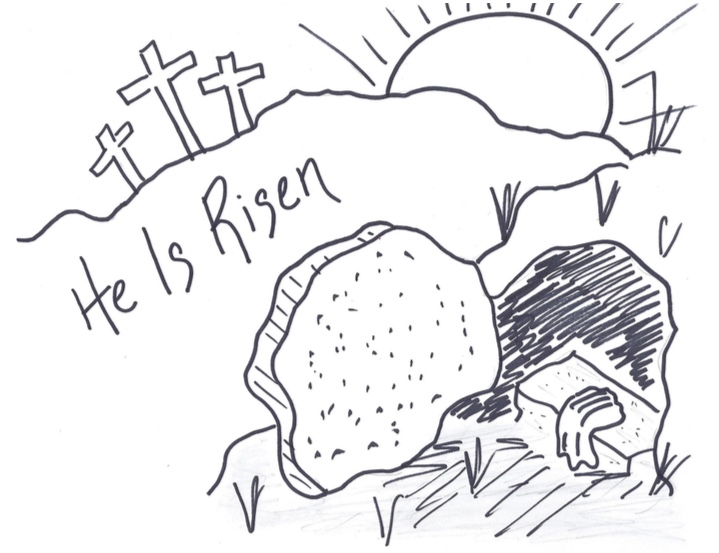
He is risen
A joyful and peace-filled Easter to all of our readers from Canon Matthew, Deacon Daniel and Father Gareth.
3 churches newsletter, 9 April 2017 – Palm Sunday
Download our 3 churches newsletter for Palm Sunday 2017 below.
Jerusalem of the heart
We come now, with Palm Sunday, to the beginning of Holy Week. I recently read of a very interesting approach to Holy Week. I like the idea that what was happening ‘out there’ and ‘back then’ as Christ entered Jerusalem, is also happening ‘in here’ and right now’. We can say that there is a “Jerusalem of the heart”. This inner life also has its temple and its palaces, its places of corruption, its gardens of rest, its seat of judgment.
Here Malcolm Guite invites us to walk with Christ. And let him walk with you on both an outer and an inner journey that leads to the cross and beyond. Read and reflect …
Now to the gate of my Jerusalem,
The seething holy city of my heart,
The saviour comes. But will I welcome him?
Oh crowds of easy feelings make a start;
They raise their hands, get caught up in the singing, And think the battle won. Too soon they’ll find
The challenge, the reversal he is bringing
Changes their tune. I know what lies behind
The surface flourish that so quickly fades; Self-interest, and fearful guardedness,
The hardness of the heart, its barricades,
And at the core, the dreadful emptiness
Of a perverted temple. Jesus come
Break my resistance and make me your home.
From Sounding the Seasons, by Malcolm Guite, Canterbury Press 2012
Please make every effort to take part in our Holy Week services, especially the Sacred Triduum, of Maundy Thursday evening, Good Friday afternoon and Holy Saturday night.
Fr Matthew
Whatever happened to Lazarus?
One of the worst bumps on the head I ever got was going down the steps into the tomb of Lazarus about 25 years ago. We were on our second September pilgrimage to the Holy Land, and were anxious to visit Bethany, where Lazarus lived with his sisters Martha and Mary. The modern village of al-Eizariya is believed to mark the spot, and there we find a church dedicated to the family, while the adjacent Tomb itself is on ground owned by Moslems. As I went down the 20 or so steps, at the bottom I banged my head on the low roof. Ouch!
So what happened to Lazarus after his raising by Jesus? He is mentioned a few times later in the Gospels, but for the time beyond that we have to rely on tradition (or legends). The Eastern tradition tells how he went with St Paul to Cyprus, becoming first bishop of present-day Larnaka. From there, as Islam advanced westwards, his relics were taken to Constantinople (Istanbul) and later to Marseille in Provence.
At this point this tradition joins another Western one, which has Lazarus and his sisters, along with the other Marys from the Crucifixion plus a maid, put out to sea by hostile Jews. They drift across the Mediterranean until they land in Provence. The beautiful town of Les-Saintes-Maries on the edge of the Camargue lies where the group traditionally landed. From here the group scatters across southern France, except for the other Marys, who stayed and gave their name to the town. Our September pilgrims also visited some of these sites in 1993 and again in 2011.
One of the strangest parts of the Eastern legends of Lazarus tells how Lazarus never smiled during the thirty years after his resurrection. He had been traumatized, we would say today, by the sight of unredeemed souls he had seen during his four-day stay in the underworld/Hades. Well I suppose being dead would have quite an effect on you, wouldn’t it? The only exception was, when he saw someone stealing a pot, he smilingly said: “the clay steals the clay.” But I’m sure Lazarus was raised again, this time not a resuscitation like in today’s Gospel, but a rising to eternal life, through Easter, which we will all celebrate in two weeks’ time.
Fr Matthew
3 churches newsletter, 2 April 2017
Download our 3 churches newsletter for the fifth Sunday of Lent, issue 13/17 below.