Category Archives: newsletter

Jesus wept

John 11:35 is the shortest verse in the English Bible – but also one of the most powerful. In this edited extract American writer Debie Thomas reflects on it.

When Jesus weeps, he legitimizes human grief. The raising of Lazarus is around the corner, but in this story, the promise of joy doesn’t cancel out the essential work of grief. When Jesus cries, he assures Mary and Martha, not only that their beloved brother is worth crying for, but also that they are worth crying with. Through his tears, Jesus calls all of us into the holy vocation of empathy, co-suffering, and lamentation.

When Jesus weeps, he respects the necessity of silence, the sanctity of the wordless and the unsayable. We should pay careful attention when the Word himself refuses to speak. Sometimes there is nothing to be said in the face of loss; sometimes tears are our best and most honourable language. Through his wordless tears, Jesus cautions us to pause. He shows us that silence, too, is faithful, sometimes, silence is love.

When Jesus weeps, he acknowledges his own mortality. When word spreads about the miracle in Bethany, the authorities decide that Jesus must be stopped. He knows that the end is imminent, he knows that his time with his friends is almost over, he knows that it’s nearly time to say goodbye to the lakes and skies and hills and stars he loves. In crying, he asserts powerfully that it is okay to yearn for life. It’s okay to cling to this beautiful world. It is okay to love and cherish the gift of life here and now.

And finally, when Jesus weeps, he shows us that sorrow is a powerful catalyst for change. It is his shattering that leads to resurrection. Perhaps Jesus’s tears can provoke us in similar ways. What breaks our hearts? What enrages us to the point of breakdown? Can we work for transformation in our places of devastation? Can our sorrow lead us to justice?

I hope that Jesus’s tears can keep us tender, open, humble, generous, and brave. I hope his honest expression of sorrow will give us the permission and the impetus we need, but to move with powerful compassion into a world that sorely needs our empathy and our love. Our journey is not to the grave, but through it. The Lord who weeps is also the Lord who resurrects.

Edited from Debie Thomas on www.journeywithjesus.net

Lenten themed music concert – Cardiff Ardwyn Singers

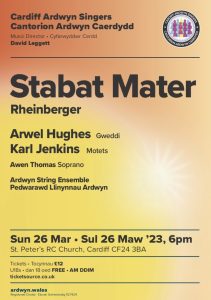
Cardiff Ardwyn Singers are delighted to present a thrilling concert of Lenten themed music at St Peter’s RC Church on Sunday 26th March at 6pm which is full of local and international colour. Motets from Karl Jenkins provide a mix of familiar music and new discoveries, while Arwel Hughes’ ‘Gweddi’ is a rousing prayer setting featuring a soaring soprano solo. German born composer and organist Josef Rheinberger gives us the jewel in the crown with his ‘StabatMater’, a setting for choir and string orchestra. 

Tickets are just £12 and free for under 18s and available via the Ticketsource website using the link: https://www.ticketsource.co.uk/cantorion-ardwyn-singers/ , or on the door.

Stabat Mater - Rheinberger, Sunday 26 March concert


Volunteer Recognition 2023 – saying ‘thank you’

Volunteers Week

The Archdiocese of Cardiff would like to invite you to nominate your volunteers, individuals or teams, to receive a ‘thank you’ for the great work they do. 

Anyone can nominate, so please do share widely.  All will receive a certificate with letter of thanks. 

  • Young People
  • Volunteer Individuals
  • Volunteer Teams
  • Specialist Volunteers
  • Emergency Voluntary Response
  • Lifetime Volunteers

There’s a full explanation of each category on the Archdiocese of Cardiff website.

You can nominate quickly via Survey Monkey, by email return using the Microsoft Word form or even write your nomination by hand and post it to Gareth Simpson, Volunteer Recognition, Archbishop’s House, 41/43 Cathedral Road, Cardiff CF11 9HD.  There are ways to include everyone if you wish by making using of the ‘Teams’ category.

This will be the third year of this initiative and the recognition is always well received.

More details are available on the Archdiocese of Cardiff website.

Closing date for nominations is Monday 17 April 2023.

Woman at the Well

This reflection is based on today’s Gospel – the Samaritan Woman. To hear a dramatic reading of it go to youtu.be/5y2GlmTxpkM or thecanonsstall.blogspot.com

I am a woman of no distinction, of little importance. I am a woman of no reputation save that which is bad. You whisper as I pass by and cast judgmental glances, though you don’t really take the time to look at me, or even get to know me. For to be known is to be loved, and to be loved is to be known. Otherwise what’s the point in doing either one of them in the first place?

I WANT TO BE KNOWN. I want someone to look at my face And not just see two eyes, a nose, a mouth and two ears; But to see all that I am, and could be – all my hopes, loves and fears. But that’s too much to hope for, to wish for, or pray for, so I don’t, not anymore. Now I keep to myself, and by that I mean the pain that keeps me in my own private jail, the pain that’s brought me here at midday to this well.

To ask for a drink is no big request, but to ask it of me? A woman unclean, ashamed, used and abused, an outcast, a failure, a disappointment, a sinner. No drink passing from these hands to your lips could ever be refreshing, only condemning, as I’m sure you condemn me now. But you don’t. You’re a man of no distinction; though of the utmost importance. A man with little reputation, at least so far. You whisper and tell me to my face what all those glances have been about, and you take the time to really look at me. But don’t need to get to know me.

For to be known is to be loved and to be loved is to be known. And you know me. You actually know me; all of me and everything about me. Every thought inside and hair on top of my head; every hurt stored up, every hope, every dread. My past and my future, all I am and could be. You tell me everything, you tell me about me! And that which is spoken by another would bring hate and condemnation. Coming from you brings love, grace, mercy, hope and salvation. I’ve heard of one to come who could save a wretch like me, and here in my presence, you say I AM He. To be known is to be loved; And to be loved is to be known. And I just met you. But I love you. I don’t know you, but I want to get to.

Let me run back to town, this is way too much for just me. There are others: brothers, sisters, lovers, haters, the good and the bad, sinners and saints, who should hear what you’ve told me; who should see what you’ve shown me; who should taste what you gave me; who should feel how you forgave me. For to be known is to be loved; And to be loved is to be known. And they all need this, too. We all do. Need it for our own..

By Student Life Creative

His prayer – and ours

Prayer is one of the big themes of Lent, and Jesus taught us his own prayer – to be ours. Here are some thoughts about it, bit by bit…

Our Father who art in heaven – We are talking to God who is “dear father” or “ dad” who loves us, not some neutral distant deity

Hallowed be thy name – Jesus starts with praise and worship, not by asking for something, as we so often do. This puts us in right relationship with God,

Thy kingdom come – This is one of Jesus favourite words. But what does it mean? Heaven? The afterlife? Some paradise?

Thy will be done on earth as it is in heaven The Kingdom is wherever God’s will is being carried out – perfectly through Jesus and in heaven. We are to bring about the Kingdom on earth by following God’s will day by day.

Give us this day our daily bread – As we pray for the coming of the Kingdom, we ask the Lord to supply our daily needs, symbolized by bread. This would also include of course the Eucharist.

And forgive us our trespasses – Now we ask for the healing of our relationship with God through forgiveness, one of Our Lord’s most important themes

As we forgive those who trespass against us – We ask the Lord to help us to forgive others as we are forgiven. Perhaps his forgiveness can only get through to us in proportion to how we forgive others…

And lead us not into temptation – Generally agreed to not be a perfect translation of the original, because God can’t lead us into temptation! “Do not put us to the test” might be better. We are weak human beings, easily tempted and quick to fall, we need help.

But deliver us from evil – Modern scholars tell us that this is personification of evil, perhaps better translated as “The evil one”.

So we can see a beautiful movement in this great prayer. We start from God, then pray His Kingdom down to earth. As it comes, we ask God to support us day by day. We then remember our relationships, with God and with our neighbour, as the Kingdom prompts us. Finally we move out into the future, asking for the Lord’s ongoing protection and strength.

There we have it – the prayer of the Lord, the Lord’s Prayer.

Fr Matthew